
 Episode 86
· 02:01
This is Brodie with Illinois Extension and I’m here with a new “voice of the wild”
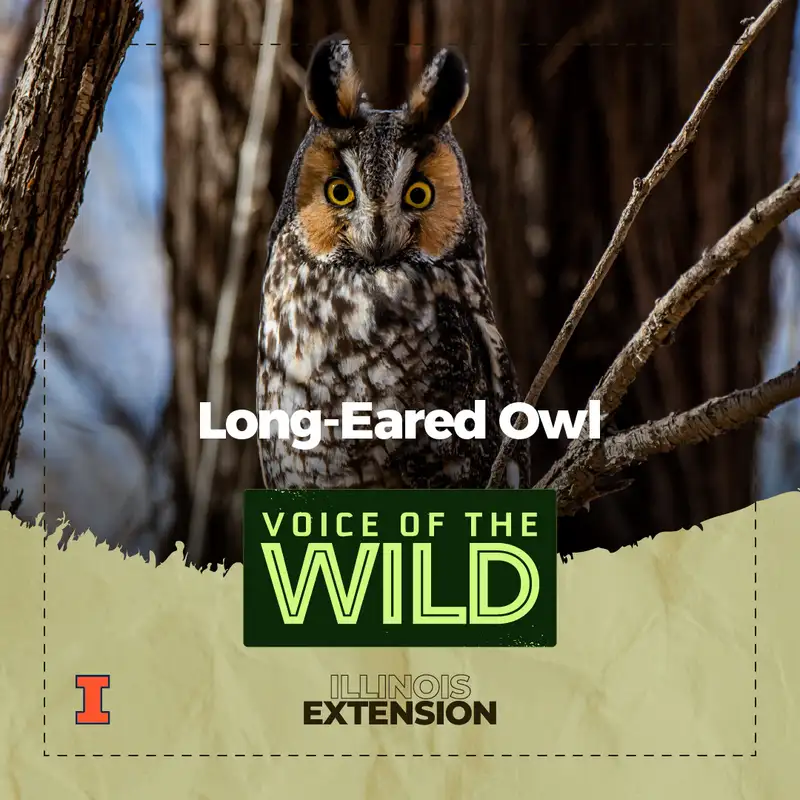
A slender and secretive owl that’s cosmopolitan in distribution but can be found in the lower Midwest only in the depths of winter. They tend to roost in mid-sized evergreens stands near open fields. I often check beneath spruce windbreaks and stands of abandoned cedars for their oblong pellets and look near the trunk for the bird’s namesake long ear tufts. This is the long-eared owl.
Those long ear tufts can, at first glance, give the appearance of a great horned owl, but the long eared owl is substantially smaller, about the size of a crow. They’re also slimmer than the great horned and have streaks that run down the body instead of across. If you do manage to find a long eared owl, be sure to look carefully in the trees nearby, as they are one of the few owls that sometimes roost communally. In our second playthrough, note that, alongside the more traditional owl hoots, the long eared has some strange barking calls that are almost coyote-like. Here’s the long-eared owl again.
Thank you to the Macaulay library at the Cornell lab for today’s sound. Learn more about voice of the wild at go.illinois.edu/VOW
Listen to Voice of the Wild using one of many popular podcasting apps or directories.